
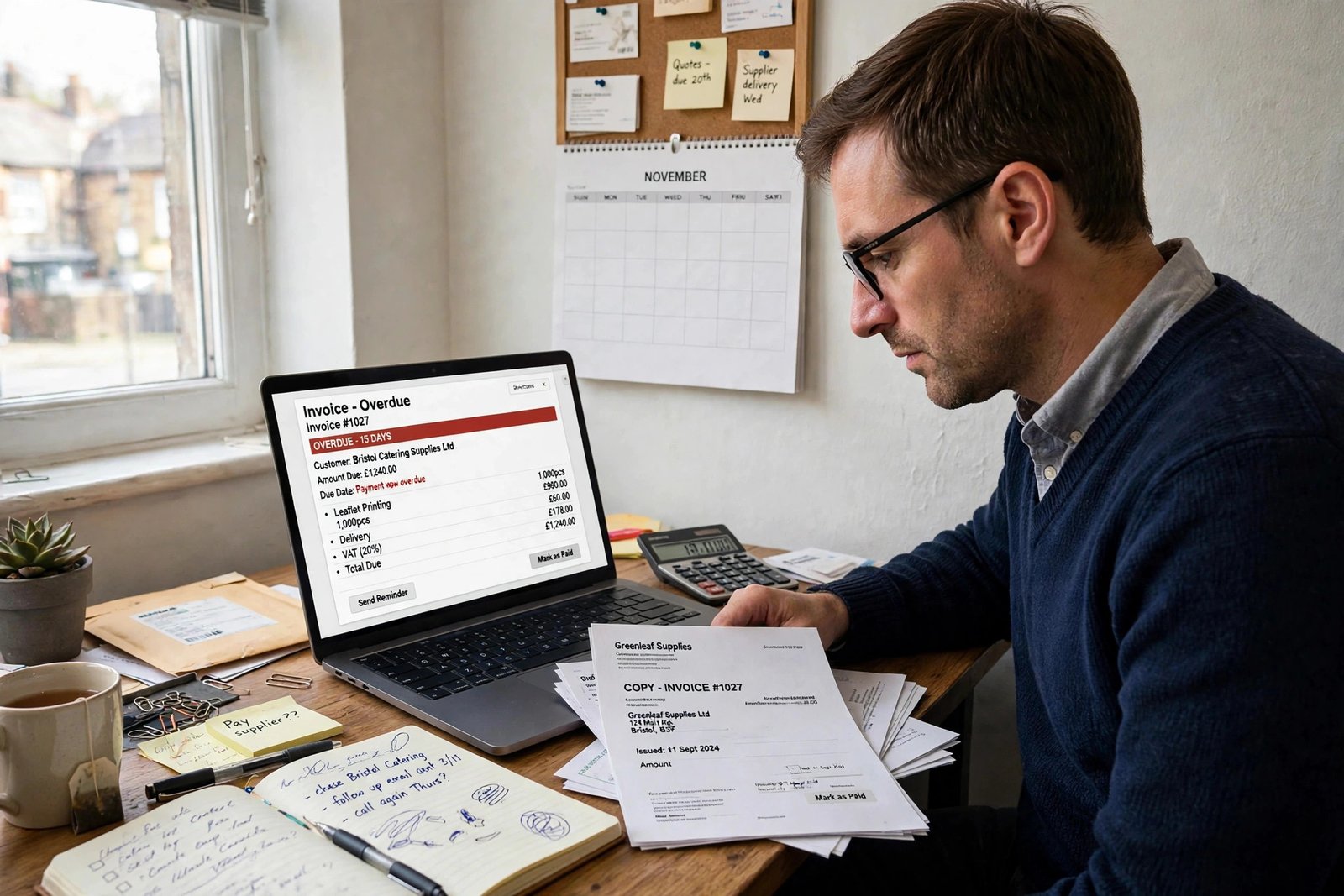
Send a polite reminder the day an invoice becomes late, call on day seven, and send a written reminder by day fourteen. On debts due in 2026 you can charge statutory interest at 11.75% a year, plus a fixed £40, £70 or £100 per invoice. If that fails, send a letter before action, then claim through the small claims court.
When is an invoice actually late?
An invoice is late the day after the payment date passes. If you agreed a payment date, that date is the deadline. GOV.UK says an agreed date must usually be within 30 days for public authorities and within 60 days for business transactions. You can agree longer than 60 days for business transactions, but only if it is fair to both businesses.
If you never agreed a payment date, the law sets one for you. The payment is late 30 days after the customer gets the invoice, or 30 days after you deliver the goods or provide the service, whichever is later. That is the default for business to business work, and it is why clear terms matter: a customer cannot claim they did not know when to pay if the date is on the invoice.
Interest starts to run from the day after the due date. So if the due date is 30 April, interest starts on 1 May. Keep the invoice date, the due date and the delivery date on file, because you need them to work out what you can claim. A clear invoice with the payment terms printed on it prevents most arguments, so read our guide on how to write an invoice in the UK before you send the next one.
What reminder sequence gets invoices paid first?
Chase in stages, and chase on time. Most late invoices are paid after a polite reminder, because the customer forgot or lost the invoice. A fixed sequence stops small debts drifting into big ones, and it gives you a paper trail if you later claim interest or go to court.
| Day | Action | What to send or say |
|---|---|---|
| Day 1 (due date passed) | Polite email reminder | Attach the invoice again, state the amount and due date, ask when payment will be made |
| Day 7 | Phone call | Confirm receipt, ask for a payment date, agree it in writing |
| Day 14 | Firm written reminder | Restate the amount, mention statutory interest and fixed compensation, give a date to pay by |
| Day 21 to 30 | Letter before action | Formal letter giving 14 days to pay, warning of court proceedings |
| After 30 days | Debt recovery or court claim | Instruct a recovery agency, use invoice factoring, or file a small claims court claim |
Send the first reminder the day after the due date. A short, polite email is enough: the invoice number, the amount and the due date, and a question about when you can expect payment. Attach the invoice again, because many late payments are simply lost invoices. If there is no reply in a week, phone. An email is easy to ignore; a call is not. Ask directly when the money will arrive, write down what the customer promises, and send a short email confirming the agreed date.
By day fourteen, be firmer. Send a written reminder that mentions statutory interest and the fixed compensation sum you can claim. Many customers pay at this point, because the debt has just become more expensive than the invoice alone. If you add interest, send a new invoice for the interest and the fixed sum, so the customer can see the full amount in one place.
What should I say when I phone about an unpaid invoice?
Keep the call short, calm and factual. Confirm the customer received the invoice and the goods or service, then ask a direct question: when will this be paid? Do not ask whether they will pay, because that invites a no. Ask when, and wait for an answer.
A simple script works well. "Hello, this is [your name] from [your business]. I am calling about invoice [number] for [amount], which was due on [date]. Can you tell me when payment will be made?" If the customer gives a date, confirm it and follow up by email. If they have a query, deal with it or agree a time to call back. If they have cash flow problems, ask how much they can pay now and when they can pay the rest, and put any instalment plan in writing.
Never be rude or threatening, and never phone repeatedly in a way that could look like harassment. One call a week, plus written reminders, is enough. Keep a note of every call: the date, who you spoke to, and what was agreed.
How much statutory interest can I charge?
Statutory interest is the interest you are legally entitled to charge another business on a late commercial payment, under the Late Payment of Commercial Debts (Interest) Act 1998. The rate is the Bank of England base rate plus 8% a year.
The base rate used is fixed twice a year. For debts that become late between 1 January and 30 June, the rate is the base rate in force on 31 December. For debts that become late between 1 July and 31 December, it is the rate in force on 30 June. The rate stays fixed for the whole six month period, even if Bank Rate changes in between.
The base rate was 3.75% on both 31 December 2025 and 30 June 2026, so debts falling due in 2026 carry statutory interest of 11.75% a year. Bank Rate rose to 4% on 5 November 2026, but that does not alter the rate for debts due in 2026. It matters for next year: debts due between 1 January and 30 June 2027 will carry 12% a year if Bank Rate is still 4% on 31 December 2026, so check the rate before you calculate interest on a 2027 debt.
Interest is simple, not compound. You calculate it on the original amount owed, including VAT, and it does not build on itself. It runs from the day after the due date until the day you are paid. You cannot claim it if your contract already sets a different late payment rate, and you cannot use a lower rate with a public authority. It applies to business to business debts only, not to consumers.
| Step | Calculation | Amount |
|---|---|---|
| Invoice total | £2,400 including VAT | £2,400.00 |
| Yearly interest at 11.75% | £2,400 multiplied by 11.75% | £282.00 a year |
| Daily interest | £282.00 divided by 365 days | £0.77 a day |
| Interest for 35 days late | £0.77 multiplied by 35 days | £27.04 |
| Fixed compensation (£1,000 to £9,999.99 debt) | Fixed sum | £70.00 |
| Total to claim | £27.04 plus £70.00 | £97.04 |
On a £2,400 invoice paid 35 days late, you can claim £27.04 in interest and £70 in fixed compensation, which is £97.04 on top of the £2,400 itself.
How much fixed compensation can I claim per invoice?
On top of interest, you can claim a fixed sum for the cost of recovering a late commercial payment. The amount is set by law and depends on the size of the debt. You can only charge it once for each payment.
| Amount of debt | Fixed sum you can claim |
|---|---|
| Up to £999.99 | £40 |
| £1,000 to £9,999.99 | £70 |
| £10,000 or more | £100 |
A £900 invoice carries £40, a £2,400 invoice carries £70, and a £12,000 invoice carries £100. The sum is compensation for your recovery costs, not extra interest, and it applies per invoice, so three unpaid invoices of £800 each carry three separate £40 sums.
On top of the fixed sum, GOV.UK says you can also claim reasonable costs of recovering the debt, such as a debt recovery agency or a solicitor, if those costs go beyond the fixed sum. Keep receipts for any costs you claim, because you may need to show they were reasonable.
If you add interest and compensation, send a new invoice showing them separately, so the customer can see exactly what they owe and why. Do not add the amounts silently to the original invoice.
What should a letter before action include?
A letter before action, also called a letter before claim, is the formal final warning before court proceedings. Courts expect you to send one and can penalise you on costs if you skip it. It is also the step that gets many debts paid, because it shows the customer you are serious.
Your letter should include the amount owed, the invoice number and date, and the due date. It should show the statutory interest and fixed compensation you are claiming, with the figures worked out so the customer can check them. Give a clear deadline, usually 14 days from the date of the letter, and say plainly that you will start court proceedings if the money is not received by then.
Keep the letter short and factual: the facts, the amount, the deadline, and the next step. Do not threaten anything you are not prepared to do, and do not add charges that are not allowed, such as an invented administration fee. Attach a copy of the invoice and a statement of the account.
Send it by recorded delivery, or by email with a read receipt, so you can prove the customer received it, and keep a copy. If the customer is an individual or a sole trader, the Pre-Action Protocol for Debt Claims expects a statement of account and the standard reply forms, and 30 days to respond. For a business to business debt, 14 days is usual.
When should I use debt recovery or the small claims court?
If reminders and a letter before action have not worked, you have three options: a debt recovery agency, invoice factoring for cash flow, or the small claims court. Choose by the size of the debt, how much time you can spend, and whether you want to keep the customer.
A debt recovery agency chases the debt for you, usually for a percentage of what it collects. That makes sense for larger debts, or when you have several unpaid invoices and no time to chase them. Compare fees first, and check whether they charge if they collect nothing. Keep the agency's invoice, because you can claim reasonable recovery costs on top of the fixed sum.
Invoice factoring explained is different: it is cash flow, not debt recovery. A factoring company advances you most of the value of your unpaid business to business invoices, typically 80% to 90% within 24 hours, then collects from your customer. You pay a service fee of around 0.5% to 3% of turnover, plus a discount charge on the money you draw. Under recourse factoring the advance is charged back to you if the customer does not pay within the agreed period, commonly 90 to 120 days.
The small claims court is the normal route in England and Wales for claims up to £10,000, filed online through Money Claim Online. The court fee runs from £35 to £455 depending on the claim. You pay up front, and if you win the court usually orders the other side to repay it. The defendant has 14 days to respond, or 28 days if they acknowledge it first. If they do not respond, you can ask for judgment in default. Scotland and Northern Ireland have separate systems, so check the rules where your customer is based.
Go to court only when the amount justifies it and you have the evidence: the contract or order, the invoice, proof of delivery, and your reminders and letter before action. Most small claims are decided on paper or at a short informal hearing, and you do not usually need a solicitor. You have six years to bring a contract claim, but do not wait: the longer you leave it, the harder it is to collect.
How do I stop invoices going unpaid again?
Prevention is cheaper than chasing. Most late payment is avoidable with a few habits that take minutes to set up and save hours of chasing later.
Check new customers before you give them credit. A quick credit check, or a look at their Companies House record, tells you whether a customer pays on time. For a large first order, ask for a deposit, or split the work into stages with a payment at each stage. A deposit of 25% to 50% is normal in many trades.
Put your payment terms on every invoice and every quote, in plain words: the amount, the due date, and what happens if payment is late. State that you charge statutory interest and fixed compensation on late business payments. Customers who know the consequences in advance pay faster.
Send invoices the day the work is done, not at the end of the month. Offer payment by bank transfer and, where you can, by direct debit, because a customer on direct debit rarely pays late. Use your accounting software to send automatic reminders on the due date and a week later, so chasing does not depend on you remembering.
Chase on day one, every time. Customers who pay late and get away with it once will pay late again. Customers who get a polite reminder the day after the due date learn that your terms are real. Review your aged debts every week, not every month, and act on the oldest first.
Finally, protect your cash flow while you chase: read our guide on how to improve cash flow in business for ways to keep the business funded while you wait. And build your credit policy into the business from the start: our guide on how to write a business plan covers the terms and payment policies that belong in your plan.
Frequently asked questions
Can I charge interest on a late invoice?
Yes, if the customer is another business. Statutory interest is the Bank of England base rate plus 8% a year: 11.75% a year for debts due in 2026, running from the day after the due date. You cannot claim it if your contract sets a different rate, and it does not apply to consumers.
What if we never agreed payment terms?
The law sets a default: the payment is late 30 days after the customer gets the invoice, or 30 days after you deliver the goods or service, whichever is later. Statutory interest and fixed compensation apply from that date, so you can still charge them without agreed terms.
Can I charge interest to a consumer customer?
No, not statutory interest. The Late Payment of Commercial Debts (Interest) Act 1998 applies to business to business debts only. For a consumer, you can only charge what your contract or terms allow, and any charge must be fair. If a consumer will not pay, use reminders, a letter before action, and a small claims court claim.
What if the customer disputes the invoice?
Ask exactly what is disputed and deal with it in writing. Check your records, including delivery notes and emails confirming the work, and reply with your position and the evidence. A court will want to see that you tried to resolve it first. Do not charge statutory interest on the disputed part while it is genuinely unresolved, and keep chasing the undisputed part.
When should I go to court?
Go to court when reminders and a letter before action have failed, the amount justifies the fee and your time, and you have the evidence to prove the debt. In England and Wales the small claims track covers claims up to £10,000, filed online through Money Claim Online. Send the letter before action first, with 14 days to pay: the court expects it.
Conclusion
Chasing unpaid invoices is a process, not a single angry email. Send a polite reminder on day one, call on day seven, and send a firm written reminder by day fourteen. Know what you can claim: statutory interest at 11.75% a year on debts due in 2026, plus a fixed £40, £70 or £100 per invoice. If that fails, send a letter before action giving 14 days, then use a debt recovery agency or the small claims court. The best time to deal with late payment is before it happens: clear terms on every invoice, a credit check on new customers, invoices sent on the day the work is done, and a reminder on day one every time.
This article is general guidance for small UK businesses, not legal advice for a specific case. Late payment law and court fees can change. Check the current GOV.UK guidance and the current Bank of England base rate before you rely on a figure, or ask a qualified adviser if your case is unusual.