Direct answer
To file a confirmation statement in the UK, log in to the Companies House online filing service, check your company details, update anything that has changed, and submit form CS01. File at least once every 12 months, within 14 days of the end of your review period. The fee is £50 online or £110 on paper.
What is a confirmation statement?
A confirmation statement, filed on form CS01, is the yearly filing that tells Companies House that the information on the public register for your company is correct. It is not a tax return and it is not your annual accounts. It is a short check of the facts Companies House already holds about your company.
The confirmation statement replaced the annual return in 2016. You may still hear older business owners call it the annual return, but the form and the name have changed. The job is the same in plain terms: confirm the record, correct it where needed, and file it on time.
Every UK limited company must file one, including a dormant company and a company that has not traded during the year. If nothing has changed, you still file. You simply confirm that the details are still correct.
Who must file a confirmation statement?
Every company registered with Companies House must file a confirmation statement. That includes:
- Private companies limited by shares
- Private companies limited by guarantee
- Public limited companies
- Dormant companies
- Companies that have not traded in the review period
- Companies with only one director and one shareholder
Sole traders and ordinary partnerships do not file a confirmation statement, because they are not registered with Companies House in the same way. If you run a limited company, this filing applies to you, even if your company made no profit and had no activity in the year.
The statement is normally filed by a director, the company secretary where one exists, or a person authorised to act for the company, such as an accountant or formation agent. Whoever files it is responsible for making sure the information is correct.
What information do you need to check?
Before you start the form, gather the facts you will need to confirm. The online service shows you the details Companies House holds, and you work through them one by one. The main items are:
Company details
Check the registered office address, the company name and number, and the nature of the business. The nature of the business is shown by SIC codes, which are short codes that describe what the company does. If the company has started a new line of business or stopped an old one, the SIC codes may need to change.
Directors and secretary
Check the names and details of every director, and of the company secretary if the company has one. If a director has left, or a new director has been appointed, that change should already have been reported to Companies House on the correct form. The confirmation statement is a check, not the place to report a director change for the first time, so sort out any appointment or resignation first if you can.
People with significant control
Check the details of every person with significant control, often called a PSC. A PSC is a person who owns or controls a large share of the company or has a large say in how it is run. If the PSC details have changed, update them through the correct PSC filing before or at the same time as you file the confirmation statement, following the GOV.UK guidance for your case.
Shareholders and share capital
Check the shareholders, the number of shares each person holds, and the total share capital. If shares have been issued, transferred or cancelled during the review period, the statement should reflect the position at the confirmation date. If you are unsure about a share change, check your company records or ask your accountant before you file, because share records are easy to get wrong.
Registered office and trading status
Check that the registered office address is still correct and that mail sent there will reach you. Companies House and HMRC use this address for official letters. A wrong address can mean you miss a deadline letter, so treat this check as important, not as a formality.
Lawful future activities
The confirmation statement also asks you to confirm that the intended future activities of the company are lawful. This is a short statement on the form. Read it carefully and only confirm it if it is true for your company.
When is a confirmation statement due?
You must file at least one confirmation statement every 12 months. The timing works around two dates that are easy to mix up, so it helps to keep them separate in your mind.
The review period is the 12 month period covered by the statement. For your first statement, it starts on the date your company was incorporated. After that, it starts the day after the confirmation date on your last statement.
The confirmation date, sometimes called the made up date, is the last day of the review period. It is the date the information in the statement is correct as at.
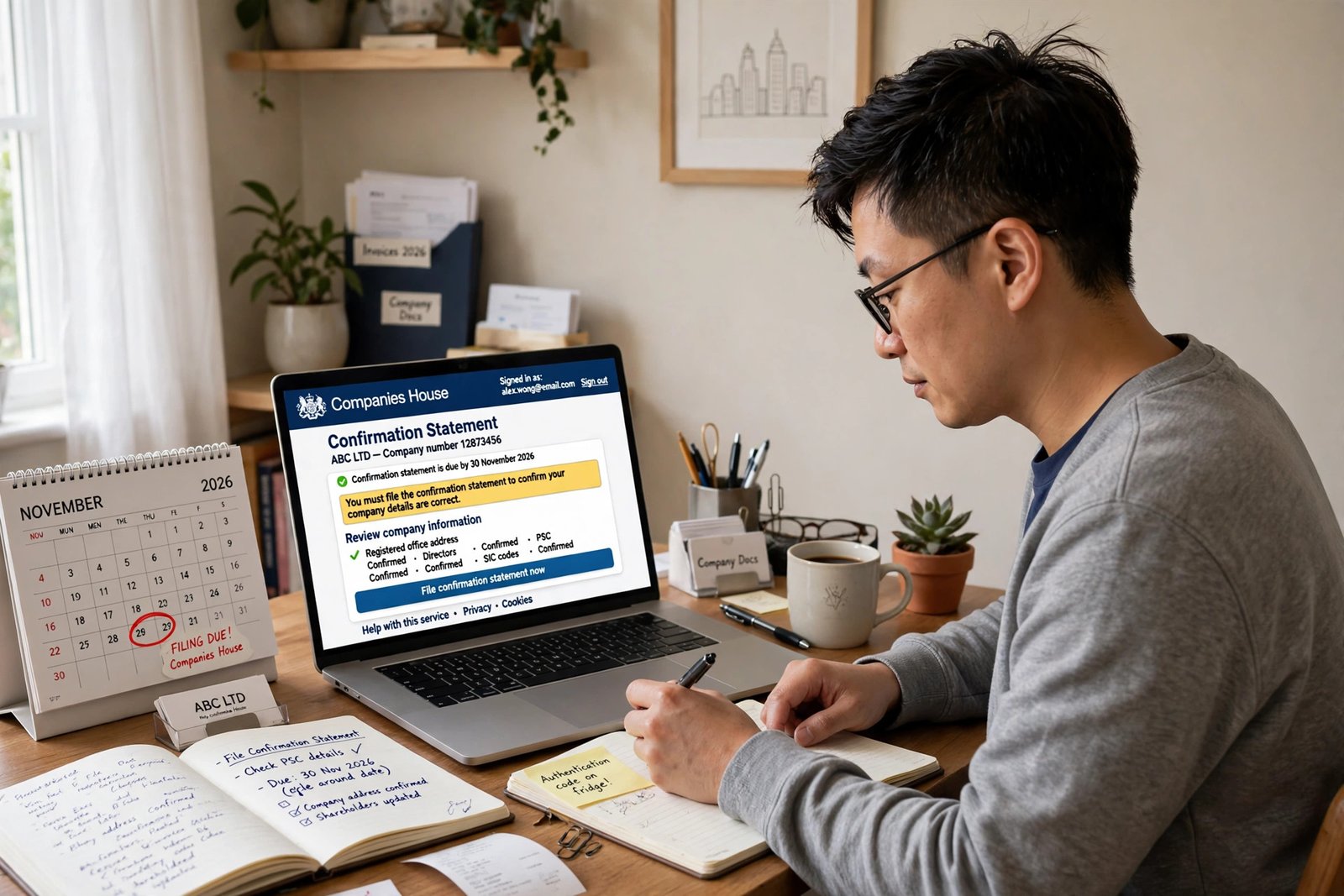
You then have 14 days after the end of the review period to file the statement. That 14 day window is your filing deadline. For example, if your review period ends on 30 November, you must file by 14 December.
You can check your exact deadline on the Companies House register. Search for your company on the Find and update company information service and look at the filing dates shown there. You can also sign up for email reminders from Companies House, which is a simple way to avoid missing the date.
You do not have to wait until the end of the review period. You can file early. If you file early, you choose a new confirmation date, and your next review period starts the day after that date. Some companies file early so the confirmation statement lines up with their annual accounts. Think before you do this, because filing early moves your next deadline as well.
How much does it cost to file a confirmation statement?
The fees below were checked on GOV.UK on 13 November 2026. Companies House changed its fees on 1 February 2026, and older guides still show the old figures, so do not rely on a guide that quotes £34 online or £62 on paper. Those were the old fees.
The fee is paid with the first confirmation statement you file in each 12 month payment period. The payment period is separate from the review period, and it cannot be changed. If you file a second statement in the same payment period, for example to correct something or to file early, you do not normally pay a second fee. Check the current Companies House fees page if you are unsure whether a fee is due with your filing.
| Filing method | Fee from 1 February 2026 | How you pay |
|---|---|---|
| Online through Companies House | £50 | By card during the online filing |
| Paper form CS01 by post | £110 | By cheque or postal order as shown on the form and GOV.UK guidance |
If an accountant or agent files for you, their service charge is separate from the Companies House fee. Ask for a clear quote before you agree, so you know what is the government fee and what is the agent fee.
How to file a confirmation statement online
Filing online is the method Companies House recommends for most companies. It is cheaper than paper, it is faster, and the service checks your answers as you go. Most small companies can finish it in one sitting if they have their details ready.
Step 1: Check identity verification first
Since 18 November 2025, identity verification has been a legal requirement for company directors and people with significant control under the Economic Crime and Corporate Transparency Act 2023. GOV.UK guidance states that Companies House will not accept your company's confirmation statement until all directors have verified their identity.
Each director verifies once and receives a Companies House personal code. Verification is free through GOV.UK One Login, or it can be done through an Authorised Corporate Service Provider, known as an ACSP. Do this well before your filing deadline. If one director has not verified, the whole filing can be held up, so check every director, not just yourself.
The transition period for directors and people with significant control who were already in post runs to 18 November 2026. Your own deadline may be earlier than that date, because for most existing directors it is tied to the date the company files its next confirmation statement. Do not wait until the last day of the transition period. Verify early and keep the personal code safe.
Step 2: Gather what you need
Before you sign in, have these items ready:
- Your company number
- Your company authentication code, which is the six character code Companies House sent to your registered office
- Your GOV.UK One Login details, if you are asked to sign in with them
- The Companies House personal code for each director, where the service asks for it
- Your company records for shares, PSCs and any changes in the review period
- A debit or credit card for the £50 fee, if a fee is due
If you have lost your authentication code, you can ask Companies House to send a new one to your registered office. Allow time for it to arrive by post. Do not leave this until the week your statement is due.
Step 3: Sign in to the Companies House online filing service
Go to GOV.UK and open the official page to file your confirmation statement. Use the link from GOV.UK rather than a link in an email, so you know you are on the real Companies House service. Sign in with GOV.UK One Login where asked, and enter your company number and authentication code when prompted.
Step 4: Work through the details shown
The service shows the details Companies House holds for your company. Work through each section in order. Confirm each item that is correct. Where something has changed, update it in the service or use the correct update form, following the prompts on screen.
Do not rush this part. The most common mistakes are small ones: a director name spelt slightly differently from the record, a share total that does not match the company register, or an old registered office address that was never updated. Read each screen before you move on.
Step 5: Give the identity verification details
When asked, provide the Companies House personal code for each director. This is the step that links identity verification to the confirmation statement. If the service will not let you continue, it may be because a director has not yet verified. Stop, complete the verification, and then return to the filing.
Step 6: Check the statement date and pay the fee
Check the confirmation date shown on the filing. Make sure it is the date you intend. If you are filing early, remember that this date becomes your new confirmation date and resets your next review period.
Pay the fee if one is due. The online fee is £50. The service will tell you the amount before you pay. Keep the payment receipt and the filing reference.
Step 7: Submit and keep the proof
Submit the statement and wait for the on screen confirmation. Companies House will also send an email confirmation. Save that email and note the date and time you filed. Check the public register a day or two later to make sure the filing shows as accepted and the confirmation date is correct. If the filing is rejected, read the reason given, correct it, and file again within the deadline if you can.
How to file a confirmation statement on paper
You can still file on paper using form CS01, but it costs more and takes longer. Paper filing may suit a company that cannot file online, or a company being restored to the register, where GOV.UK guidance says a paper form may be needed. For most small companies, online filing is the better choice.
Step 1: Get the current CS01 form from GOV.UK
Download the current version of form CS01 and its extra parts from GOV.UK. Use the current version, not an old copy saved on your computer, because the form has been updated to include the identity verification statement and other recent changes. Print it at full size on white A4 paper.
Step 2: Fill in the form carefully
Work through the form section by section. Enter the company number, company name, confirmation date and the details to be confirmed. Add the identity verification statement for directors where the form asks for it. Check every entry against your company records before you move on, because a mistake on paper is harder to fix than a mistake caught on screen.
Step 3: Sign, pay and post the form
Sign the form where required and enclose payment for the £110 paper fee, using the payment method shown on the form and GOV.UK guidance. Post it to the Companies House address shown on the form. Allow enough time for the post to arrive within the 14 day filing window. The filing date for a paper form is based on when Companies House receives it, so do not post it on the last day and assume it will arrive in time.
Step 4: Wait for confirmation and check the register
Paper filings take longer to process than online filings. Keep a copy of the completed form and proof of posting. Check the public register after a reasonable time to make sure the statement has been recorded. If it has not appeared, contact Companies House and have your company number and posting date ready.
Online filing versus paper filing
| Factor | Online filing | Paper filing (CS01) |
|---|---|---|
| Fee from 1 February 2026 | £50 | £110 |
| Speed | Submitted at once, with on screen checks | Slower, with postal time and manual processing |
| Mistakes | The service flags some errors as you go | Errors are more likely and take longer to correct |
| Payment | By card during filing | By cheque or postal order as shown on the form |
| Best for | Most small companies | Companies that cannot file online or must use paper for their case |
Confirmation statement versus annual accounts
Many new directors confuse the confirmation statement with the annual accounts. They are two separate filings with different jobs and different deadlines.
| Item | Confirmation statement (CS01) | Annual accounts |
|---|---|---|
| What it does | Confirms company details on the register are correct | Shows the financial position of the company |
| Filed with | Companies House | Companies House, and tax information goes to HMRC |
| How often | At least once every 12 months | Once a year, with a filing date based on the accounting period |
| Main deadline rule | Within 14 days of the end of the review period | Within 9 months of the accounting year end for a private company, but check your own date |
| Fee from 1 February 2026 | £50 online, £110 on paper | No Companies House fee for the accounts filing itself in the usual online route, but check current guidance |
| Who it covers | Every limited company, including dormant companies | Every limited company, including dormant companies in most cases |
Filing one does not count as filing the other. If you file your confirmation statement, you must still file your accounts by their own deadline. If you file your accounts, you must still file your confirmation statement.
What happens if you file late?
There is no small automatic late fee for a confirmation statement in the same way as there is for late accounts. That does not mean a late statement is safe to ignore. GOV.UK guidance states that Companies House may issue a financial penalty and your company may be struck off the Companies House register if you do not file your confirmation statement. GOV.UK also states that you can be fined up to £5,000 if you do not file.
In practice, a short delay that you fix quickly is less serious than a statement that stays unfiled for weeks or months. If you miss the deadline, file as soon as you can, and do not wait for a reminder letter. If the company has been struck off or is at risk of being struck off, take advice straight away, because restoring a company is a longer and more costly process than filing on time.
Set a reminder for your next review period as soon as you file. Put the date in your calendar, and add a second reminder a month before it. Many late filings happen because the date was never noted down, not because the form was hard.
Identity verification: what directors and PSCs need to know
Identity verification is now part of filing a confirmation statement, not a separate chore you can leave until later. The main points for a small company are:
- Every director must verify their identity. People with significant control must also verify.
- Verification became a legal requirement on 18 November 2025.
- You verify once, through GOV.UK One Login or through an Authorised Corporate Service Provider.
- After verification, you receive a Companies House personal code. Keep it safe and do not share it in a way that could let someone else act as you.
- You provide the personal code as part of the confirmation statement filing.
- New directors appointed on or after 18 November 2025 must verify before they are appointed, so build this step into any appointment plan.
- The transition period for people already in post ends on 18 November 2026, but your own deadline may be earlier, tied to your next confirmation statement date.
If a director lives overseas or does not have a UK passport, they can still verify. GOV.UK guidance explains the routes available, including verification through an Authorised Corporate Service Provider. Check the GOV.UK identity verification pages for the current options before you start.
Common mistakes to avoid
- Filing late because the review period and the payment period were mixed up. The review period sets the deadline. The payment period sets when the fee is due.
- Using old fee figures from an out of date guide. Check the current fee on GOV.UK before you pay.
- Leaving identity verification until the filing week, then finding the statement cannot be accepted.
- Confirming details that are wrong, especially share totals and PSC details, without checking the company records first.
- Filing early without realising it resets the next review period and moves the next deadline.
- Assuming the accounts filing covers the confirmation statement. It does not.
- Posting a paper form on the deadline day and assuming it will arrive in time.
A simple checklist before you submit
Use this list as a final check before you press submit or post the form.
- Review period end date and filing deadline checked on the Companies House register.
- Registered office address, directors and PSC details checked against company records.
- Shareholders and share capital checked.
- SIC codes checked against what the company does now.
- Every director has verified their identity and has a personal code ready.
- Confirmation date checked and understood, including if you are filing early.
- Fee checked on GOV.UK, with payment ready if a fee is due.
- A copy or screenshot of the submitted statement saved, with the filing reference.
Frequently asked questions
How often do I need to file a confirmation statement?
At least once every 12 months. The review period lasts 12 months, and you must file within 14 days of the end of that period. You can file more often if you need to update the record, but you must not file less often than once a year.
Can I file a confirmation statement if nothing has changed?
Yes. Most companies file a statement with no changes in most years. You still file, and you still pay the fee if one is due in that payment period. You confirm that the details on the register are still correct.
How long does it take to file a confirmation statement online?
If your details are ready and every director has verified their identity, most small companies can complete the online filing in one sitting. Allow extra time for the first filing, or if you need to check share records or PSC details. Do not start it in the last hour before the deadline.
What is the difference between a confirmation statement and an annual return?
The confirmation statement replaced the annual return in 2016. The annual return was the old form. If someone asks you for an annual return now, they almost always mean the confirmation statement on form CS01. The duty is the same in plain terms: check the register record once a year and confirm it.
Do dormant companies need to file a confirmation statement?
Yes. A dormant company must still file a confirmation statement and, in most cases, annual accounts as well. Dormant means the company has had no significant transactions, not that it has no filing duties. Check the GOV.UK dormant company guidance for your exact case.
What happens if I lose my authentication code?
You can ask Companies House to send a new authentication code to your registered office address. It arrives by post, so allow time for delivery. You cannot file online without it, so request a new code as soon as you realise it is lost.
Conclusion
Filing a confirmation statement is a short yearly job, but it matters. It keeps the public record for your company correct, and it keeps your company in good standing with Companies House. File online where you can, check every detail against your company records, sort out identity verification early, and file within 14 days of the end of your review period.
If you are unsure about shares, PSCs or a change in the year, ask your accountant before you file. A short check before you submit is far easier than correcting a wrong filing after it is on the public record. Put your next confirmation date in your calendar now, and next year the filing will take far less time.
This article is general guidance for small UK companies, not legal or accounting advice for a specific company. Fees, deadlines and identity verification rules can change. Check the current GOV.UK and Companies House pages before you file, or ask a qualified adviser if your case is unusual.